
Articles >>
Armoured Personnel Carrier
Category: Term of the day
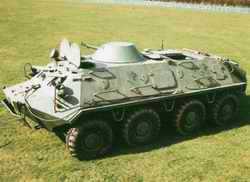
Armoured personnel carriers (APCs) are armoured fighting vehicles developed to transport infantry on the battlefield. They usually have only a machine gun although variants carry recoilless rifles, anti-tank guided missiles (ATGMs), or mortars. They are not really designed to take part in a direct-fire battle, but to carry the troops to the battlefield safe from shrapnel and ambush. They may have wheels or tracks. Examples include the American M113 (tracked), the British FV 432 (tracked), the French VAB (wheeled), the German Boxer MRAV (wheeled) and the Soviet BTR (wheeled). More heavily armed and armoured are Infantry fighting vehicles, which are designed for direct combat. During World War I, when the tank was developed, the British Mark V tank was designed with a small passenger compartment to carry troops. By some definitions this can be considered the first armoured personnel carrier. The first specialised APC was the Mark IX of 1918.
During World War II, half-tracks such as the American M3 and the German SdKfz 251 played a role similar to the armoured personnel carriers that were developed later on. Another forerunner to the APC during this time was the British Universal Carrier. Often, APCs were simply armoured cars with the capacity for carrying troops, but they evolved into purpose-built vehicles to suit the demands of motorised warfare from World War II.
In 1944, the commander of 2nd Canadian Corps, General Guy Simonds, ordered the conversion of 72 US-produced M7 Priest self-propelled howitzers to personnel carriers. They were, at the time, being replaced by the British Ordnance QF 25 pounder, and no future plans had been drawn up for them. The howitzer was removed, and the resulting hole was plugged with whatever steel was available. The vehicle was called Kangaroo, after the workshop which did the conversion, which was codenamed Kangaroo. Later in the war Canadian-built Ram tanks were used as a basis for the majority of conversions, as they were then obsolete and the original Kangaroos were worn out.
After the war different specialised APCs were developed. The United States developed a series of tracked vehicles, culminating in the M113 'box on tracks', of which 80,000 were made. The Soviet Union developed the wartime BTR-40 into a series of 8-wheeled APC.
At the end of the 1980s, Israel converted captured T-55 tanks to APCs, reminiscent of WWII conversions. The result is one of the best protected APCs in the world, called IDF Achzarit.
The infantry fighting vehicle is a development of the armoured personnel carrier concept.
Most armoured personnel carriers use a diesel engine comparable to that used in a large truck or in a typical city bus (APCs are often known to troops as 'Battle Taxis' or 'Battle Buses'). The M113 for instance used the same engine as the standard General Motors urban bus. A single M113 moving at top speed generates as much noise as a General Motors urban bus moving at top speed. However, the typical armoured personnel carrier can carry only six to ten soldiers while a typical urban bus can carry thirty to fifty seated passengers and many more standing passengers, in the aisle.
Most APCs are amphibious. Usually tracked APCs are powered by their tracks in the water, and wheeled APCs have propellors or water jets. Preparations for amphibious operations usually comprises checking the integrity of the hull and folding down a trim vane in front. Swimming required fairly still waters, and good entry and exit points. Speed in water is typically 3-6 km/h.
Armour on APCs are usually composed of simple steel or aluminium, sufficient for protection against small arms fire and most shell fragments. Just about any type of anti-tank weapon can defeat the armour of an APC.
The usual armament for an APC is a 12.7 (.50") or 14.5 mm heavy machine gun. This is mounted on top of the vehicle, either on a simple pintle mount, sometimes with a gun shield, or a small turret. Sometimes an automatic grenade launcher is used instead. |
Sergyi Way |

Otokar offers solutions with technology transfer and local manufacturing models
13.09.2019
Triple-digit million euro contract for Rheinmetall
14.10.2018
Rheinmetall unveils the Lynx KF41 Next-Generation Combat Vehicle
18.06.2018
Eurosatory 2018: Patria 6X6 - Multifunctional transport capacity far into the future
12.06.2018
Discuss
 C1 Ariete AMV (Modernization of the vehicle)
 C1 Ariete (Main battle tank)
 M1074 JABS Wolverine (Armoured vehicle-launched bridge)
 M1150 ABV Shredder (Mine clearing vehicle)
 CALIBER FLEX (Robot, Unmanned Vehicle)
 AVATAR (Robot, Unmanned Vehicle)
 Manul (Infantry fighting vehicle)
 K9 VAJRA-T (Self-propelled howitzer)
 PPDU (Remote controlled weapon station)
 2S43 Malva (Self-propelled howitzer)
 ? (Robot, Unmanned Vehicle)
 ISV (Patrol Vehicle)
 T-90MS Tagil (Modernization of the vehicle)
 AGEMA (Robot, Unmanned Vehicle)
 Centaur (Robot, Unmanned Vehicle)


