
Articles >>
Camouflage research blending in with future ADF needs
Category: Future Technologies
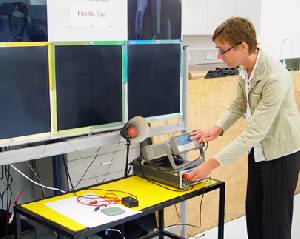
Research that could significantly enhance the Australian Defence Force (ADF) vehicle camouflage scheme has commenced - in unassuming form, on a light board at the back of a Defence Science and Technology Organisation (DSTO) laboratory, in Melbourne. The work is focussed on the development of electrochromic materials that change colour with subtle variation in applied voltage. It now forms the basis of a new collaboration with the University of South Australia. “An outcome is still some years off,” explains DSTO researcher Vivienne Wheaton, “but the ADF has expressed interest in the concept.” Currently, ADF vehicles are coated with a paint scheme, devised by DSTO, according to a standard specifying colours and near-infrared properties. “Historically, we have developed camouflage that works very well against specific backgrounds. However, backgrounds change, obviously, by moving from one location to the next – and the ADF can expect to deploy vehicles to a wide variety of operational areas.” “Even if we stay motionless in the same position, the same scene can look very different at different times of the day, under different weather conditions and throughout different seasons. A camouflage scheme that worked effectively in one instance may be completely ineffective in another,” she says. Indeed, Australia’s military deployment since the 1960s attests to the variety of environments that the armed forces are expected to operate in: Vietnam, the Gulf, East Timor and the Solomon Islands, each with comparative geographical differences that required specific camouflage to suit respective environments. Vivienne powers the small concept display in the DSTO laboratory – a voltage supply connected to five board-mounted polymer film panels, known commercially as ‘SPD- Smart’ film. “The panels are purchased samples of electrochromic material that can be deposited onto glass or other polymer surfaces,” Vivienne says. Within moments, the densely coloured panels illuminate to a murky green; minimally at first, but enough to visualise the potential of the energy transfer at play – as a chameleon lizard alters it appearance to avoid prey, could a military vehicle’s camouflage change, to enhance its safety? Applied voltage changes the alignment of small particles in the film, to give a darker or lighter appearance depending on orientation of the particles. The SPD smart film is a high voltage system, but other types of smart materials exist that are low voltage, low power systems more suitable for camouflage applications. “Applied voltages of less than 5 V will generally initiate colour changes in electrochromic materials, where the change is a result of the chemical species switching between oxidation states.” “We’re talking about electrochromic pixels that are only effective in the visible band.” That poses a problem for future implementation of this form of technology. “It’s important that modern camouflage covers most of the electromagnetic spectrum – from visible light, through infrared and radar wavelengths, because battlefield sensors exploit many different parts of the spectrum.” In short, a military vehicle suitably camouflaged to one, or few parts of the electromagnetic spectrum, is potentially exposed to other parts – increasing its ‘visibility’ to hostile parties. “A number of adaptive technologies are under development throughout China, North America and Europe, focusing on different parts of the electromagnetic spectrum, but integrating them into a multi-spectral solution is a significant future challenge.” As this work is at a concept stage, there are still many technical challenges to surmount. “If this technology were to be developed to create an adaptive camouflage system, ideally the materials would be controlled so as to respond automatically to changes in the environment around them.” “That would require sensors, integrated with the system, to sense the environment and appropriate signal processing to make enough sense of the environment’s stimuli, and effectively guide the colour transition and pattern generation,” Vivienne says. “Most current implementations of electrochromics use materials like glass or shiny films that are not well suited to a camouflage application on military vehicles.” Accordingly, DSTO is progressing a related PhD collaboration with the University of South Australia, to investigate the science behind the panels, with the view to developing the concept into something that can go into the field. “The collaboration is examining the challenge of developing electrochromics that can be packaged in a more robust, field-ready way.” “If we can resolve these field issues for electrochromic materials, in the future we may be able to assist the ADF with adaptive improvements to their camouflage systems.” Vivienne disconnects the modest concept display – the SPD films at once return to charcoal black again. |
DSTO |
SMEs collaborate to develop thermal signature defence solution
16.07.2019
EOS launches new ultra light R150
08.09.2018
Australia Orders 211 Boxer Wheeled Armoured Vehicles
17.08.2018
Defence Science and Technology Organisation - DSTO
Australian Defence Business Review
Discuss
 C1 Ariete AMV (Modernization of the vehicle)
 C1 Ariete (Main battle tank)
 M1074 JABS Wolverine (Armoured vehicle-launched bridge)
 M1150 ABV Shredder (Mine clearing vehicle)
 CALIBER FLEX (Robot, Unmanned Vehicle)
 AVATAR (Robot, Unmanned Vehicle)
 Manul (Infantry fighting vehicle)
 K9 VAJRA-T (Self-propelled howitzer)
 PPDU (Remote controlled weapon station)
 2S43 Malva (Self-propelled howitzer)
 ? (Robot, Unmanned Vehicle)
 ISV (Patrol Vehicle)
 T-90MS Tagil (Modernization of the vehicle)
 AGEMA (Robot, Unmanned Vehicle)
 Centaur (Robot, Unmanned Vehicle)


 RSS
RSS